What is Visual Quality Control? A Revolution in Industry Thanks to AI
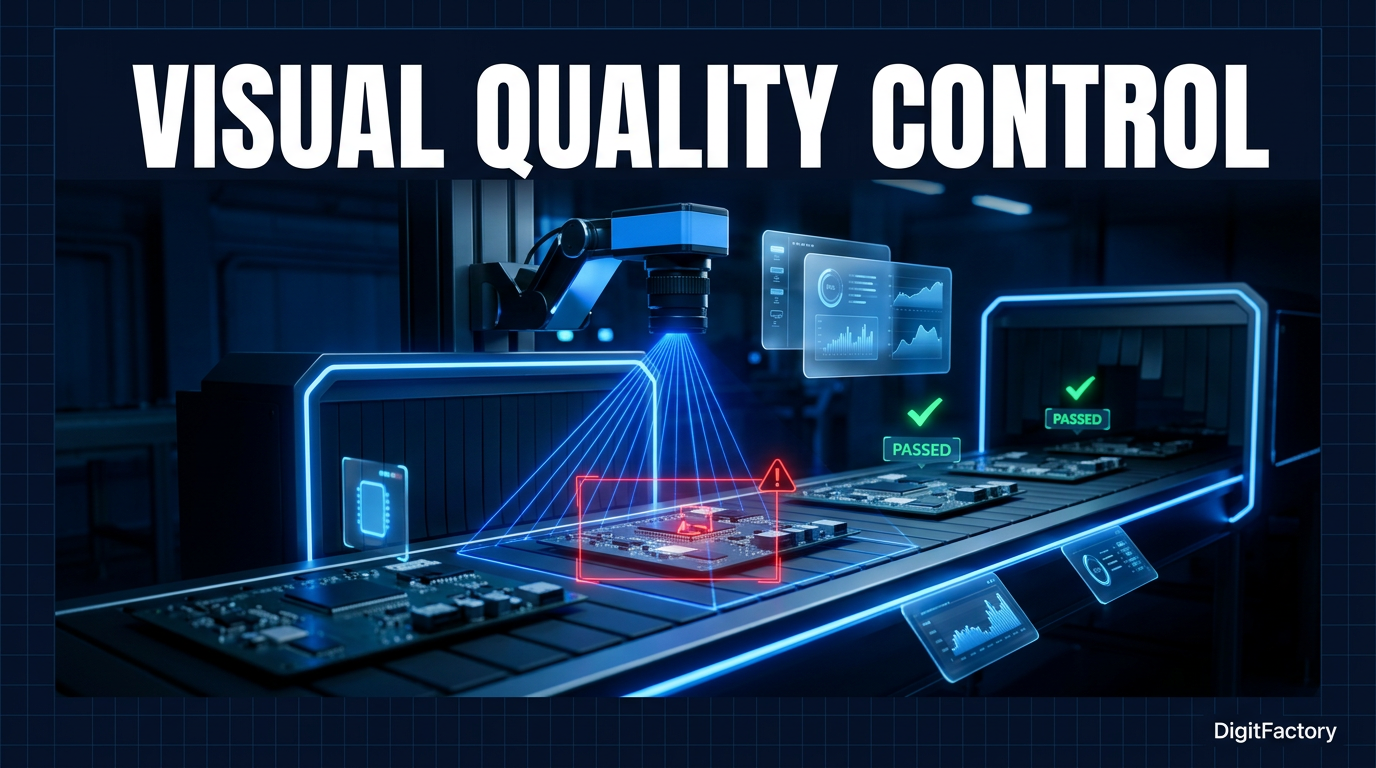
In today's dynamically changing industrial world, where precision, efficiency, and reliability are key, traditional quality control methods often prove insufficient. The Industry 4.0 era brings with it innovative solutions that are revolutionizing the way companies ensure the quality of their products. One of the most groundbreaking is visual quality control, also known as AI Vision.
Traditional visual inspection, based on the human eye, although a standard for years, is burdened with inherent limitations. Fatigue, subjectivity of assessment, and the physical limitations of human sight mean that even the most experienced inspectors can overlook defects, especially microscopic ones or those that occur with high frequency. In response to these challenges, visual quality control enters the scene, using advanced artificial intelligence technologies and vision systems to ensure unparalleled accuracy and repeatability of inspections.
The importance of quality control in industry cannot be overstated. Without it, companies are exposed to huge financial losses resulting from defective products, complaints, loss of reputation, and customer dissatisfaction. The introduction of visual quality control systems not only minimizes these risks but also opens the way to optimizing production processes, increasing efficiency, and building a competitive advantage.
DigitFactory - AI Vision Pioneer: DigitFactory, with 8 years of experience in industrial automation (PLC/SCADA) and deep knowledge of the latest AI technologies, is a pioneer in providing intelligent solutions for the manufacturing sector. It specializes in the implementation of AI Vision systems that combine advanced industrial cameras with the computing power of NVIDIA Jetson, creating practical solutions that work in real factory environments.
What is Visual Quality Control (AI Vision)?
Visual quality control, often referred to as Automated Visual Inspection (AVI) or Machine Vision, is an advanced technology that uses cameras, image processing software, and artificial intelligence algorithms to automatically inspect products for defects, non-conformities, and other quality issues. Unlike the human eye, vision systems are able to work without fatigue, with constant precision and at a much higher speed, which allows for 100% production inspection.
The basic principles of visual quality control are based on several key stages:
- Image acquisition: High-resolution industrial cameras, often supported by specialized lighting and optics, capture images of products. Lighting is key to highlighting potential defects and ensuring optimal conditions for analysis.
- Image processing: The collected images are then processed by advanced algorithms. At this stage, the system can correct distortions, improve contrast, remove noise, and prepare the image for further analysis.
- Analysis and decision: This is the heart of the AI Vision system. Using machine learning models, the system analyzes the processed images, comparing them with patterns of defect-free products. The algorithms are trained on large datasets containing images of both correct products and those with defects, which allows them to learn to recognize even subtle inconsistencies.
Key components of a visual quality control system
An effective visual quality control system is a complex architecture, consisting of hardware and software elements working in harmony:
1. Hardware:
- Industrial cameras: The heart of any vision system are the cameras that capture images from the production line. These can be 2D cameras, and in more advanced applications, also 3D cameras that provide information about the depth and geometry of the object.
- Lighting: Proper lighting is absolutely crucial for obtaining high-quality images. Different types of lighting (e.g., diffused light, structured light, backlighting) are used depending on the type of defects to be detected and the properties of the product surface.
- Optics: Lenses and optical systems ensure that the camera captures sharp and detailed images, necessary for precise analysis.
- Processing units: Real-time image analysis requires a lot of computing power. DigitFactory systems use platforms such as NVIDIA Jetson, which enable local AI processing.
2. Software:
- Image processing algorithms: This is a set of instructions that manipulate images to improve them, segment them, extract features, and prepare them for AI analysis.
- Machine learning models: These are algorithms that, after being trained on data, learn to recognize patterns and anomalies. In visual quality control, these models are able to identify defects, measure dimensions, verify assembly, and classify products with extraordinary accuracy.
- User interfaces: Intuitive interfaces allow operators to monitor the system's operation, configure inspection parameters, and view results in real time.
- Integration tools: The software must seamlessly communicate with other industrial automation systems, such as PLC (Programmable Logic Controllers) or SCADA (Supervisory Control and Data Acquisition) systems.
Integration with 3D technology (for advanced applications)
Integration with 3D vision technology takes quality control to the next level. Unlike traditional 2D systems, 3D vision captures depth and space information, providing a more comprehensive view of the product. 3D scanners collect detailed measurements, which is essential in smart manufacturing and allows for the detection of defects that are invisible in two dimensions.
Advantages and Benefits of Implementing Visual Quality Control
The implementation of visual quality control in production processes brings a number of measurable benefits that translate into a significant improvement in efficiency, cost reduction, and increased competitiveness of the enterprise.
Increased precision and accuracy
One of the most important advantages of visual quality control is its unparalleled precision and accuracy. Unlike the human eye, which is prone to fatigue, distraction, and subjective assessment, AI Vision systems operate with unwavering consistency. They are able to detect defects with sizes of fractions of a millimeter (e.g., up to 0.25 mm, as in the case of DigitFactory solutions), which are invisible to humans.
Speed and efficiency
Vision systems are characterized by extraordinary speed of operation, which allows for real-time product inspection, even at very high production line speeds (e.g., up to 60 frames per second, which DigitFactory offers). This makes it possible to monitor 100% of production, not just random samples, which is the standard in manual control.
Cost reduction and process optimization
An investment in visual quality control quickly pays for itself, generating significant savings and optimizing processes on many levels:
- Reduction in the number of defects: Automatic detection of defects at an early stage of production allows for immediate correction of processes, which in effect leads to a drastic reduction in the number of defective products. DigitFactory declares a reduction in defects of over 80%.
- Less material and waste loss: Quick identification and rejection of defective elements minimizes the waste of raw materials and semi-finished products, which has a direct impact on lower operating costs and more sustainable production.
- Relieving employees: Automation of routine and repetitive inspection tasks frees employees from monotonous work, allowing them to focus on more complex and valuable tasks.
- Quick return on investment (ROI): Thanks to the mentioned benefits, visual quality control systems are often characterized by a very quick return on investment, often less than 6 months.
Measurable effects: DigitFactory's solutions provide a reduction in defects of over 80% and a return on investment in less than 6 months, making them a strategic investment in the future of the company.
Improved safety and compliance with standards
Visual quality control contributes to improving product safety by eliminating defects that could pose a threat to users. This is particularly important in industries such as pharmaceuticals, medical, or automotive, where rigorous quality and safety standards are an absolute priority.
Traceability and data archiving
Modern vision systems offer 100% product traceability by archiving product images (especially defective ones - NOK), generating detailed quality reports, and providing audit data. This comprehensive documentation is invaluable in the event of complaints, internal and external audits, as well as in the process of continuous production improvement.
How does Visual Quality Control work in practice?
The implementation of a visual quality control system is a process that requires careful planning and integration with the existing production infrastructure. The key to success is not only advanced technology, but also the right approach to implementation and adapting the solution to the specific needs of a given plant.
Implementation process: Pilot with a guarantee of success
DigitFactory uses a cooperation model that minimizes risk for the client and maximizes the chances of success. The process often begins with a quick pilot, lasting only a few weeks. The aim of the pilot is to verify the value of the solution on the client's specific production line.
"DigitFactory offers a success-fee model, which means that full payment is made only after achieving the agreed Key Performance Indicators (KPIs). Such an approach demonstrates the company's confidence in the effectiveness of its solutions and builds trust among business partners."
Integration with existing systems
One of the key features of intelligent AI Vision solutions is their ability to seamlessly integrate with existing industrial automation systems. DigitFactory systems are designed to easily communicate with:
- PLC (Programmable Logic Controllers) systems: This enables two-way data exchange, where the vision system sends OK/NOK (good product/defective product) signals to the PLC controller.
- SCADA (Supervisory Control and Data Acquisition) systems: Integration with SCADA allows for central monitoring and management of the quality control process, collection of historical data, and generation of real-time reports.
- Data archiving: DigitFactory vision systems ensure 100% product traceability by archiving images, especially those with detected defects (NOK).
Examples of applications of visual quality control
Visual quality control is used in countless industrial scenarios, contributing to improving quality and efficiency in many sectors:
- Manufacturing: In the general manufacturing industry, AI Vision systems are used to inspect components for surface defects, correct assembly, the presence of all elements, as well as to verify dimensions and shapes.
- Automotive: In the automotive industry, visual quality control is key to ensuring the safety and reliability of vehicles. The systems inspect engine parts, body elements for paint defects, welds, and also control the assembly of subassemblies.
- Electronics: In electronics manufacturing, where components are getting smaller and more complex, AI Vision is indispensable. It is used to inspect printed circuit boards (PCBs) for correct soldering, and the presence and orientation of components.
- Pharmacy and Medicine: In these industries, where errors can have catastrophic consequences, visual quality control guarantees the highest standards. The systems check the integrity of drug packaging, the presence of leaflets, the correctness of labels, and also inspect medical devices.
Summary: The Future of Quality Control with AI
Visual quality control is not just a tool for detecting defects, but above all a strategic investment in the future of the company. In the era of Industry 4.0, where data and automation play a key role, AI Vision systems are becoming the foundation of modern, effective, and competitive production. They offer unparalleled precision, speed, and repeatability, eliminating the limitations of human inspection and opening up new possibilities for process optimization.
Thanks to solutions such as those offered by DigitFactory, manufacturing companies can not only significantly reduce the number of defects and operating costs, but also increase safety, ensure full product traceability, and build a strong market position. Visual quality control is a step towards a smart factory, where quality is built into every stage of production, and technological innovations support development and business success.
We invite you to contact DigitFactory to learn more about how intelligent AI solutions can revolutionize quality control in your company and provide measurable business effects.
References
- What Is Visual Inspection for Quality Control?. MaintainX. Available at: https://www.getmaintainx.com/learning-center/what-is-visual-inspection-for-quality-control
- What Is a Quality Assurance Machine Vision System. UnitX. Available at: https://www.unitxlabs.com/resources/quality-assurance-machine-vision-system/
- Machine vision basics: definitions, uses, and benefits. Cognex. Available at: https://www.cognex.com/what-is/machine-vision